
Project 02 · Diploma Project · Five-student Team · June 2024
Smart Walking Stick Using Arduino
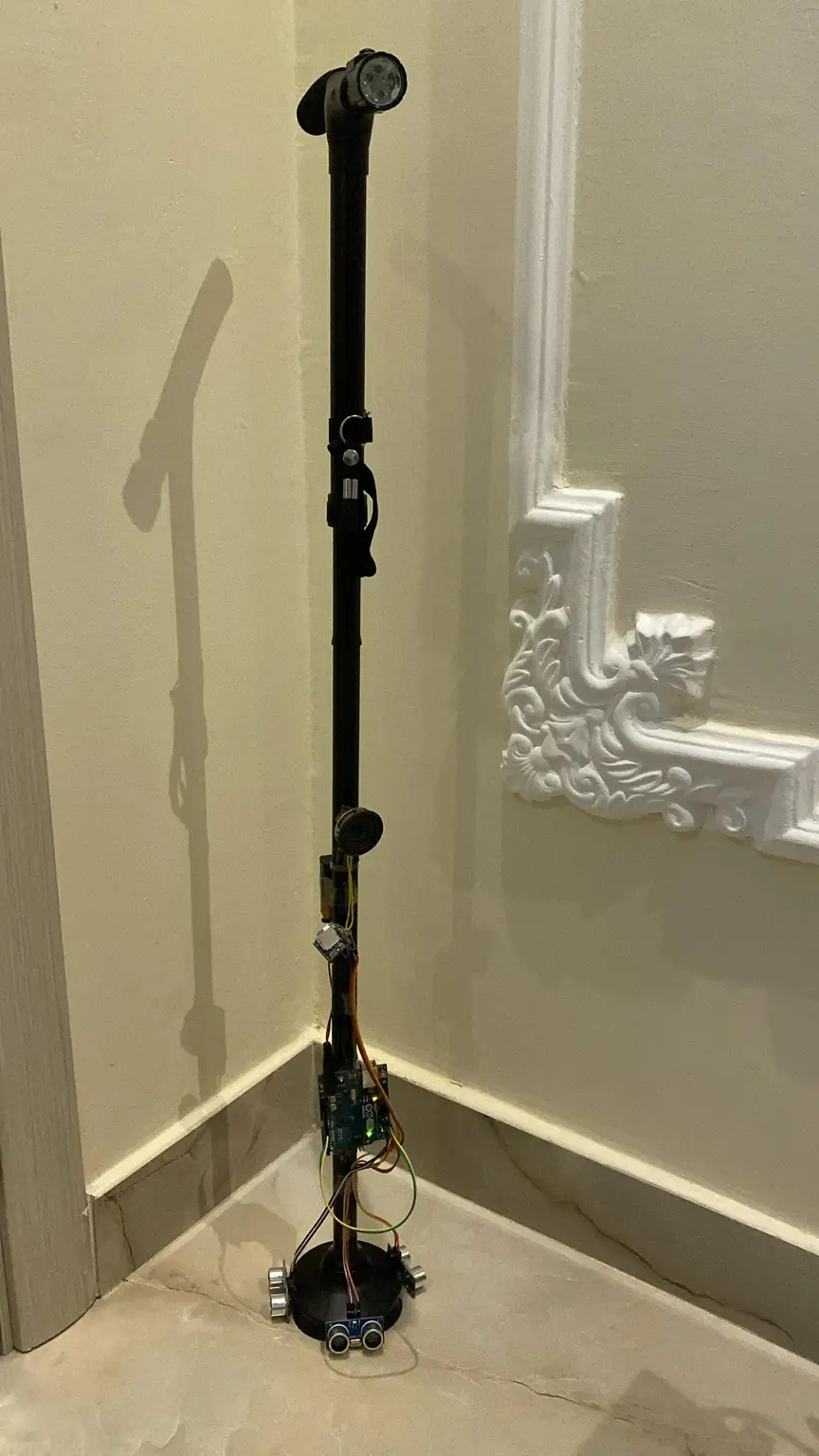
An Arduino-based assistive navigation prototype using three ultrasonic sensors, LED feedback and direction-based audio warnings.
Problem
Visually impaired users and elderly individuals can benefit from immediate obstacle feedback during navigation. This project explored a low-cost prototype combining distance sensing with LED and audio warnings.
Constraints
Five-student diploma project using an Arduino Uno R3, three HC-SR04 ultrasonic sensors, LED indicator, DFPlayer Mini, speaker, SD card and physical walking-stick structure.
My specific contribution
Within the five-student team, I worked on the Arduino programming, three-sensor integration, LED and direction-based audio-warning workflow, prototype integration and testing. The project was completed collaboratively with the other team members.
Process
- Configured three ultrasonic sensors to monitor the user’s surroundings and return obstacle-distance readings to the Arduino Uno.
- Programmed the Arduino to calculate distance and activate an LED when an obstacle entered the configured safety range.
- Connected a DFPlayer Mini and speaker to issue direction-based audio warnings; different tracks could represent different obstacle directions.
- Used Arduino IDE for programming and Tinkercad for circuit simulation, then tested startup, sensor detection, controlled distances, LED response, audio response and multiple-sensor operation.
What went wrong and how it was fixed
Reliable obstacle feedback from three ultrasonic sensors required careful testing so that the system could process multiple distance readings without confusing the user. I programmed and tested the Arduino logic to trigger LED and direction-based audio warnings when an obstacle entered the configured safety range. Controlled-distance testing also showed that environmental conditions and small or irregular objects can affect ultrasonic readings; this limitation was documented for future work with complementary sensors and additional user testing.
Result
The prototype demonstrated how low-cost sensors, an Arduino microcontroller and audio feedback can support safer, more confident navigation. Environmental conditions, irregular objects, battery efficiency and ergonomic integration remain areas for improvement.
Reflection
The project highlighted the importance of combining technical testing with practical user needs. Future iterations could add vibration feedback, complementary sensors, improved power efficiency and structured testing with target users.
Image gallery
Project repository
Explore the source files
The public repository includes the available project documentation, source material and supporting files.
View source code on GitHub